


Italy - The Sunday Times World Library
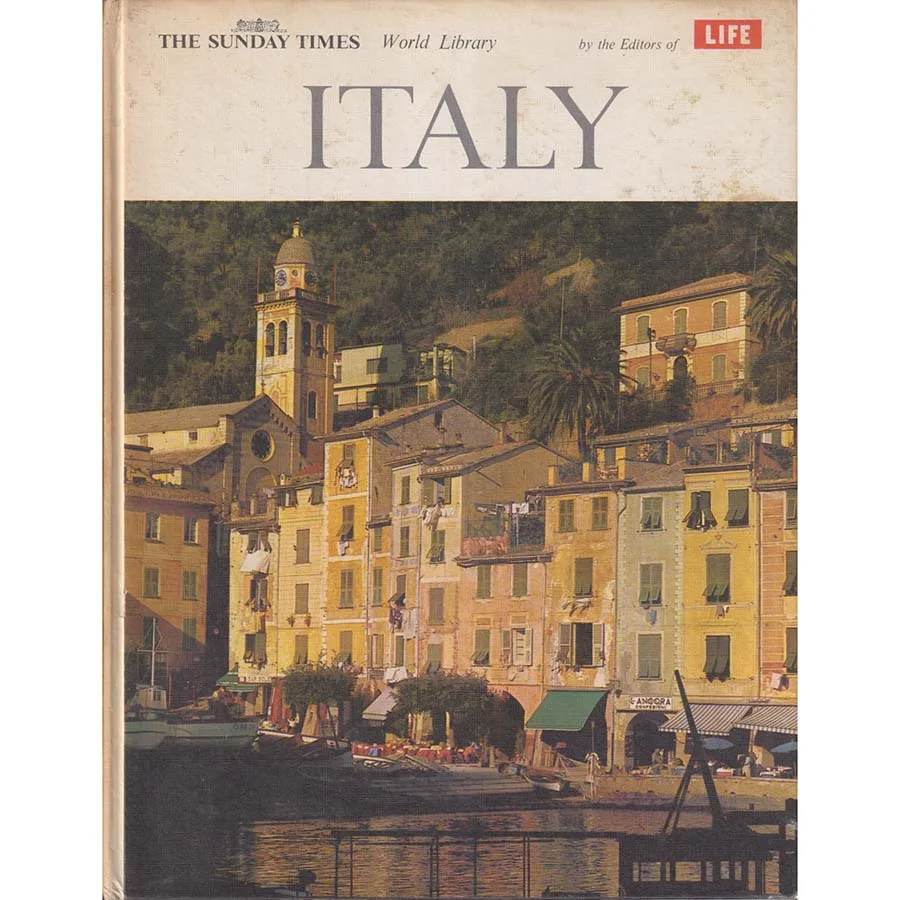
Publisher: The Sunday Times
Format: Hardback
ISBN: none
Italy - The Sunday Times World Library (1961) by Herbert Kubly – The Sunday Times
ISBN: None
Condition: Good
Italy, 1961. A country of Roman ruins, Renaissance palaces, Vespas, Fiat 500s, immaculate tailoring, noisy piazzas, strong coffee and a national ability to make even hanging out the washing look faintly cinematic.
Published by The Sunday Times as part of its World Library series, Herbert Kubly’s Italy sets out to explain the country in the grand old-fashioned style: history, geography, industry, agriculture, cities, customs, people and culture, all packed into one respectable volume for the benefit of anyone unable simply to ask their telephone.
And what a time to capture Italy.
The country was in the middle of its post-war economic miracle, rapidly changing from a largely agricultural society into one of Europe’s major industrial economies. New roads were being built, factories were expanding, millions of Italians were moving from the rural south to the industrial north, and increasing prosperity was putting scooters, refrigerators, televisions and small cars within reach of ordinary families.
In other words, modern Italy was arriving.
It was just arriving rather stylishly.
The Italy presented here sits fascinatingly between two worlds. There is the ancient Italy of churches, villages, vineyards, ruins and traditions that had survived for centuries, alongside a newer Italy of motorways, manufacturing, expanding cities and people enthusiastically discovering that owning a washing machine was considerably easier than beating clothes against a stone.
Rome naturally gets plenty of attention, because Rome has never been particularly shy about its historical importance. Few cities can casually place a traffic roundabout beside something built by an emperor and behave as though this is perfectly ordinary.
Then there is Florence, where the Renaissance appears to have got slightly out of hand and left behind enough paintings, sculptures and architecture to keep tourists wandering around with aching feet for several lifetimes.
Venice, meanwhile, continues its improbable existence as a major city apparently designed by somebody who considered roads unnecessarily conventional.
Milan represents a different Italy altogether: industrial, fashionable, energetic and increasingly prosperous. Turin was home to Fiat and the great factories of the north, where enormous numbers of Italians were employed producing the little cars that would eventually appear in approximately every second photograph taken in Italy during the 1960s.
And further south there was another Italy again, where poverty remained widespread and the economic transformation taking place in the north had arrived much more slowly.
That contrast is one of the things that makes a book like this particularly interesting today. The Italy of 1961 was changing extremely quickly, and this volume caught it during the transformation rather than after historians had conveniently divided everything into chapters.
Vintage geographical books also possess a peculiar advantage over modern ones: almost everything in the photographs becomes interesting eventually.
A street scene originally included merely to demonstrate everyday life may now contain a dozen classic cars. A perfectly ordinary shopfront becomes a vanished piece of commercial history. Clothing that nobody bothered mentioning suddenly looks impossibly elegant. A family sitting outside a café can become more evocative than the famous cathedral supposedly occupying the centre of the photograph.
The people who produced books such as this could not possibly have known which details future readers would find fascinating.
That is precisely why they are fascinating.
Herbert Kubly was an American writer and journalist with a particular connection to Italy, and his understanding of the country gives the book more personality than a straightforward encyclopedia entry. He had already written extensively about European life and brings the perspective of somebody interested not merely in where things are, but in how people actually live among them.
There is also the reassuringly confident tone of early-1960s reference publishing.
Italy will be explained.
The editors have photographs.
There are maps.
Important men have been interviewed.
Nobody needs to click "read more".
It is difficult not to admire the certainty of it all.
Naturally, the Italy described here is not today’s Italy. The population has changed, industry has changed, politics has changed, tourism has exploded and many of the small towns and landscapes shown in the book will have altered considerably.
The espresso, however, is probably much the same.
For anyone interested in Italy, European history, post-war society, vintage travel writing, photography or 1960s publishing, the book now works as both a guide to the country and a time capsule of a remarkably important period in its development.
It would also make an excellent present for somebody who loves Italy but already owns enough bottles of olive oil.
There is something especially appealing about seeing Italy before mass tourism fully transformed many of its best-known destinations. Before cheap flights deposited millions of weekend visitors into Venice, Florence and Rome every year, books like this were one of the principal ways people encountered foreign countries without actually going there.
You could therefore tour Italy from an armchair.
There were fewer airport queues.
Your luggage could not be lost.
And absolutely nobody charged you €8 for a bottle of water overlooking Piazza San Marco.
Condition: Good. A vintage copy showing the normal signs of age and previous ownership expected from a book published in 1961, but remaining in good overall condition and perfectly suitable for reading, collecting or placing strategically on a shelf to suggest a sophisticated knowledge of continental Europe.
A handsome period portrait of Italy at the moment when scooters were plentiful, motorways were new, and nobody had yet thought of putting pineapple on a pizza and then arguing about it internationally.
Sold by Crappy Old Books, where the books are old, the descriptions are unnecessarily long, and international travel remains considerably cheaper when undertaken from the sofa.
Keep browsing: See more Travel books Other books by Herbert Kubly
